Dental X-Rays: How Much Radiation Is That, Really?
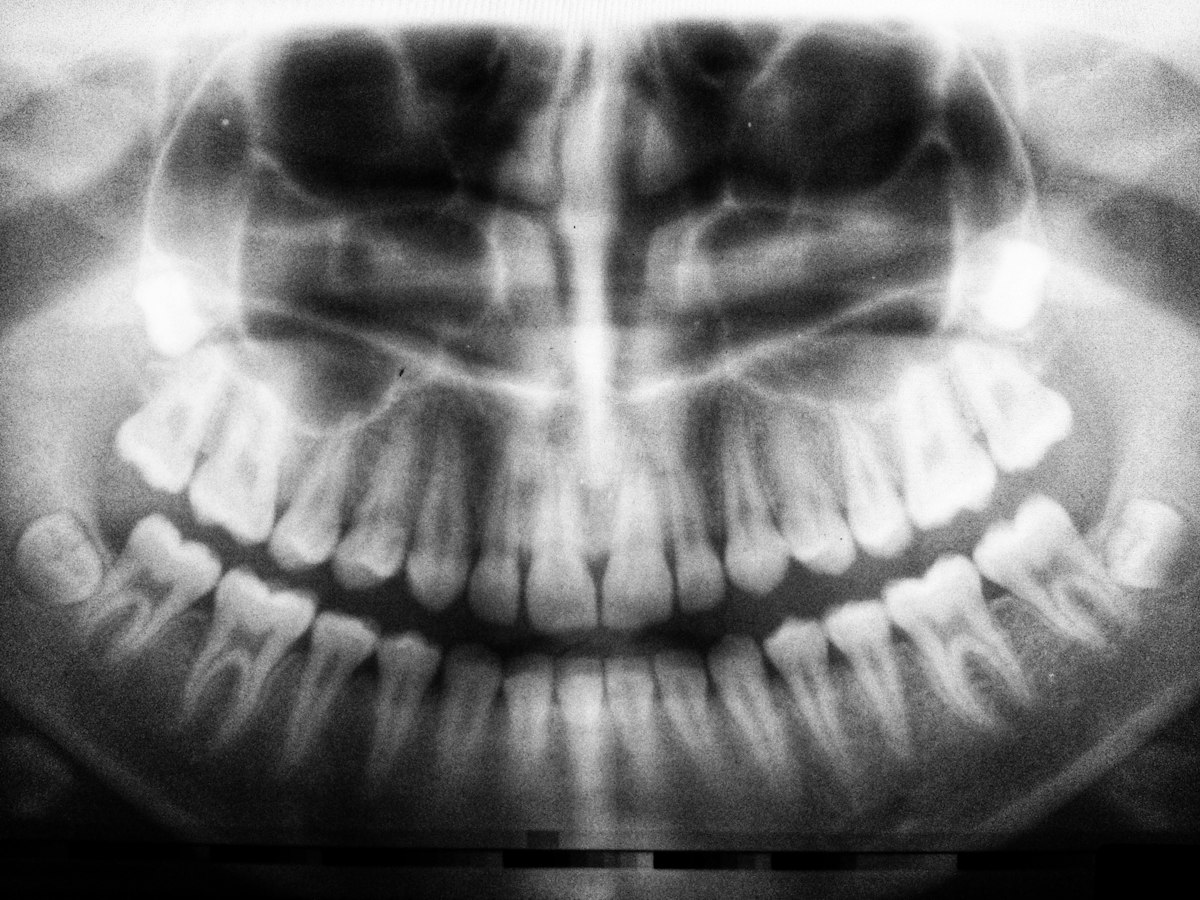
Few medical moments trigger the question “is this really necessary?” as reliably as an X-ray at the dentist. The honest answer: dental doses are among the smallest in all of medicine — and the question is still legitimate, because every image needs a reason.
The doses at a glance
| Exam | Effective dose (approx.) | Equals background radiation of |
|---|---|---|
| Single image (one tooth) | 0.005 mSv | a few hours to half a day |
| Panoramic (OPG) | 0.01–0.03 mSv | 1–2 days |
| 3D scan (CBCT), small field | 0.05–0.1 mSv | 3–6 days |
| 3D scan (CBCT), large field | 0.1–0.3 mSv | 1–3 weeks |
| For comparison: head CT | 1–2 mSv | several months |
For context: the average U.S. resident receives about 6 mSv per year from natural and medical sources — roughly 0.016 mSv per day. A single dental X-ray is about half a day of living; a flight to New York delivers more dose than a panoramic image.
CBCT: the 3D scan and its spread
Cone-beam computed tomography (CBCT) produces three-dimensional images — important before implants, or for impacted wisdom teeth. The dose depends heavily on the imaged volume (field of view) and device settings, which is why the range runs from barely more than a panoramic to ten times that. Modern guidelines require choosing the smallest useful volume. Peer-reviewed meta-analyses (notably Ludlow et al., 2015) confirm these figures.
The right question: is the image justified?
Radiation protection runs on the principle of justification: an image is right when its benefit — a better diagnosis, a safer treatment — clearly outweighs the minimal risk. You’re always entitled to ask your dentist what an image is for and whether an older one still suffices. Good practices answer gladly; the American Dental Association’s current guidance explicitly calls for ordering radiographs judiciously.
Wondering where the lead apron went? That’s covered in Why the lead apron is disappearing.
Sources
- Ludlow et al.: Effective dose of dental CBCT — a meta-analysis (2015)
- Overview of dental doses 2010–2020 (2021)
- ADA: Updated recommendations on radiography safety (2024)